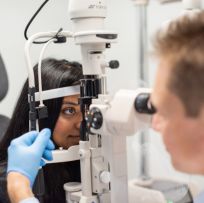
If your child has been diagnosed with myopia, you’re facing an important decision about which treatment approach will work best for your family. Both Stellest lenses and low-dose atropine therapy are proven, effective treatments that slow myopia progression. Neither is universally better than the other. The right choice depends on your child’s age, lifestyle, prescription, and your family’s preferences. Understanding how these two treatments differ will help you make an informed decision about protecting your child’s vision for a lifetime.
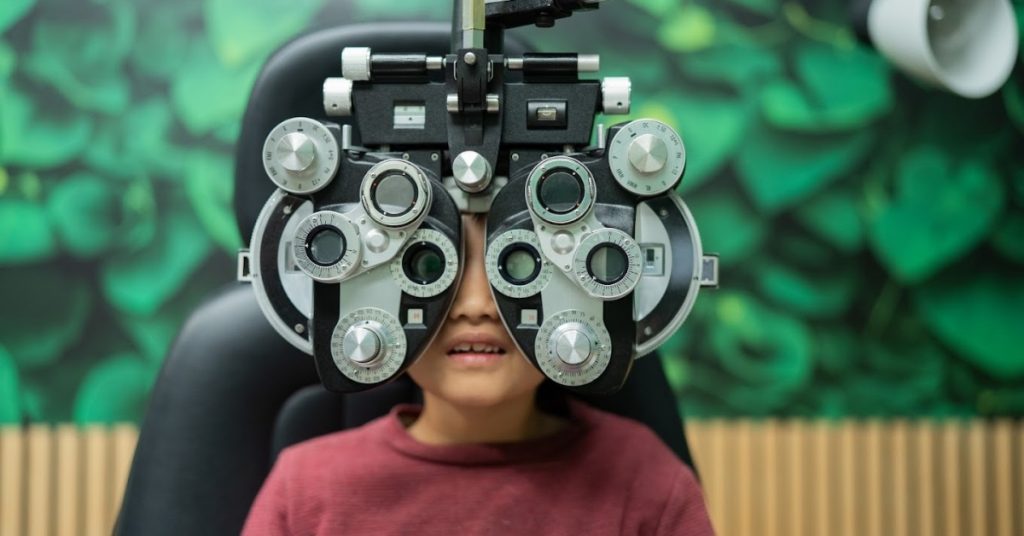
How the Treatments Work

The First Few Days: What to Expect
Stellest lenses use H.A.L.T. (Highly Aspherical Lenslet Target) technology to slow myopia progression through optical means. The lens features a clear central zone for normal vision, surrounded by 1,021 tiny aspherical lenslets arranged in 11 concentric rings. These lenslets create a controlled volume of light in front of the retina, sending a biological signal to the eye to slow its elongation. Your child looks through the clear center for all activities while the technology works continuously in the background.
Stellest lenses received FDA authorization in September 2025, making them the first FDA-authorized eyeglass lenses specifically designed to help slow myopia progression in children. They look like regular glasses, and your child won’t notice the lenslets or experience visual disturbances. The lenses provide vision correction and myopia control in a single solution.
Atropine: Pharmacological Myopia Control
Low-dose atropine works through pharmacological means, using medication to affect the biochemistry of eye growth. Atropine is an anticholinergic blocking agent that plays an important role in ocular tissues and slows the axial elongation of the eye. The treatment involves applying eye drops nightly, typically at concentrations between 0.01% and 0.05%. Atropine has been used in ophthalmology for decades, and recent research over the past 20 years has established ultra-low doses as safe and effective for myopia control in children.
The medication slows the biochemical signals that cause the eyeball to elongate abnormally. Unlike Stellest, atropine doesn’t provide vision correction, so children typically wear regular single-vision glasses during the day for clear vision, then apply the eye drops at night for myopia control. This means two separate interventions rather than a single solution.
Clinical Effectiveness
Stellest Efficacy
The evidence supporting Stellest comes from a rigorous U.S. randomized, double-masked clinical trial involving children aged 6 to 12 years. Over two years, children wearing Stellest lenses showed 71% less refractive progression and 53% less axial elongation compared with children wearing standard single-vision lenses. Axial elongation is the physical lengthening of the eyeball that drives all the disease risks associated with myopia.
What does 71% reduction mean in practical terms? If a child would typically progress by 1.00 diopter per year without treatment, Stellest could reduce that to approximately 0.30 diopters per year. Over five years of childhood growth, that’s the difference between accumulating 5.00 diopters versus 1.50 diopters, dramatically reducing lifetime risk of vision-threatening complications.
Atropine Efficacy
Research on low-dose atropine demonstrates varying levels of myopia control depending on concentration. The LAMP Study showed that 0.05% atropine reduced progression by approximately 50% over two years, while 0.025% and 0.01% concentrations showed progressively lower efficacy. Higher concentrations within the low-dose range (0.05%) provide myopia control that approaches the effectiveness of Stellest lenses. The LAMP Study, a randomized, double-masked trial with 438 children ages 4-12, demonstrated efficacy at doses of 0.05%, 0.025%, and 0.01%. The LAMP Study, a randomized, double-masked trial with 438 children ages 4-12, demonstrated that 0.05% atropine reduced myopia progression by approximately 50% over two years, with lower concentrations showing proportionally less effect.
Daily Treatment Experience
Side Effects and Considerations
Stellest Side Effects
Stellest lenses have minimal side effects because they work through optical means rather than medication. Children experience no systemic effects, no light sensitivity, and no changes to their eyes beyond the intended slowing of progression. The most common challenge isn’t a side effect but rather compliance—ensuring children wear their glasses consistently throughout the day.
Some children initially notice a brief adaptation period as their eyes adjust to the new optical design, but this typically resolves within days. The lenses don’t cause headaches, visual disturbances, or discomfort when fitted properly. The primary limitation is that effectiveness depends entirely on wear time. If your child forgets their glasses or refuses to wear them, the treatment can’t work.
Atropine Side Effects
At ultra-low doses (0.01% to 0.05%), atropine has minimal side effects. A 2021 clinical trial of 400 children over 2 years found that in the first year, 23% of children using 0.02% atropine and 24% using 0.01% atropine experienced mild photophobia (light sensitivity) in bright sunlight. However, no discomfort occurred in normal indoor or daily outdoor light, and the photophobia was easily resolved by wearing sunglasses or sun hats during outdoor activities.
By the second year, side effects decreased significantly, though a smaller percentage of children still experienced mild photophobia in bright sunlight. No serious adverse events or allergic reactions were reported. The key finding is that side effects, when they occur, are mild and manageable. Higher concentrations of atropine (above 0.1%) cause more significant light sensitivity and near vision blur, which is why modern myopia management protocols use ultra-low doses.

Ideal Candidates
Children Who Thrive with Stellest
Contact Sports Strategy
Practical Considerations
Convenience and Lifestyle Fit
Stellest offers daytime convenience with no nightly routines. Once your child puts on their glasses in the morning, treatment is happening automatically throughout the day. There’s no medication to remember, no timing to worry about, no supplies to reorder. The challenge is ensuring consistent all-day wear, which requires your child to be responsible about keeping their glasses on and not losing them at school or during activities.
Atropine offers nighttime convenience with minimal daytime impact. The medication administration takes just a minute or two before bed. However, parents must remember the nightly routine, keep the medication properly stored (typically refrigerated), and ensure they don’t run out of drops. Some families find nightly medication routines easier to remember than monitoring all-day glasses wear. Other families prefer not adding medications to their child’s regimen when an optical alternative exists.
Cost and Insurance
Cost structures differ significantly between these treatments. Stellest lenses involve an upfront cost for the glasses (frames plus specialty lenses), with updates needed as your child’s prescription changes or they outgrow frames. Many vision insurance plans provide some coverage for frames and lenses, though specialty myopia control lenses may or may not be fully covered. Once purchased, there are no ongoing supply costs beyond normal glasses maintenance.
Atropine involves ongoing prescription costs. The medication must be refilled regularly, and compounding pharmacy costs vary. Some medical insurance plans may cover atropine when documented as medically necessary treatment to prevent disease progression, while others may not. Additionally, your child still needs regular single-vision glasses for daytime vision correction, so there are costs for both the medication and eyewear.
Monitoring and Follow-Up
Both treatments require similar monitoring schedules. Comprehensive evaluations every six months track visual acuity, eye health, and axial length measurements. The follow-up protocols are comparable regardless of which treatment you choose. The key difference is what you’re monitoring: with Stellest, we’re assessing wear-time compliance and optical effectiveness; with atropine, we’re monitoring medication response and any side effects.
Combination Therapy
When Both Treatments Work Together
For some children, combining Stellest lenses with low-dose atropine provides maximum myopia control. This combination approach is typically recommended for rapid progressors who are advancing faster than 1.00 diopter per year, children with very strong family history of high myopia, or kids showing inadequate response to a single treatment modality despite good compliance.
Combination therapy addresses myopia progression through two different mechanisms simultaneously: optical control through Stellest’s lenslet technology and pharmacological control through atropine’s effect on eye growth biochemistry. Research suggests that combining treatments may provide additive benefits for children at highest risk of developing high myopia and its associated complications.
The decision to use combination therapy depends on your child’s age, current prescription, rate of progression, growth patterns, and response to initial treatment. Our eye care team will discuss whether combination therapy makes sense for your child’s specific situation.

Making the Right Choice for Your Child
No Wrong Answer
The most important thing to understand is that both Stellest and atropine are proven, effective treatments. There isn’t one treatment that’s universally better than the other. Both slow myopia progression significantly compared to no treatment. Both have excellent safety profiles. Both require consistency and commitment from families. The best choice depends on your child’s unique circumstances, not on which option generates the most impressive statistics.
Questions to Ask Yourself
The Highest Rated Eye Care Center In Orange County

What Our Patients are Saying
“Insight vision has great customer service staff n the best optometrist Ive ever seen
Dr Nathan Schramm spends as much time as needed n has the highest advanced technology. I highly recommend this practice for anyone with any vision problem.”
⭐⭐⭐⭐⭐
Nancy B.
“Everyone there was really nice. From the front desk to the doctor, they were all very nice and accommodating. Rachel was the one who taught me how to put contact lenses in my eyes and she was super patient with me. Definitely recommend this place.”
⭐⭐⭐⭐⭐
Tim S.
Our Comprehensive Approach
At Insight Vision Center, we offer comprehensive training in all four myopia management modalities: Stellest, orthokeratology, MiSight contact lenses, and atropine. This breadth of knowledge means our treatment recommendations are truly individualized rather than pushing patients toward whatever we happen to offer. We’ll evaluate your child’s eyes, discuss your family’s lifestyle and preferences, and recommend the treatment approach that makes the most sense for your unique situation.
Our clinical team includes internationally recognized leaders in pediatric myopia control. Dr. Thanh Mai, OD, FSLS, FIAOMC serves on the Treehouse Eyes Leadership Team, bringing national-level knowledge to every patient interaction. Families travel from across the globe to receive myopia management at our practice, establishing our position as leaders in this field. Whether we recommend Stellest, atropine, or another modality, you can trust that the recommendation is based on decades of combined experience and the latest research.

Schedule Your Complimentary Myopia Evaluation
The best way to determine whether Stellest or atropine is right for your child is through a comprehensive myopia evaluation. We offer a no-charge assessment that includes complete eye health examination, comprehensive refraction to determine the exact prescription, axial length measurement to establish baseline eye length, binocular vision assessment, risk factor evaluation examining family history and visual environment, and discussion of all treatment options with personalized recommendations.
Contact us at (714) 942-1361 to schedule your child’s complimentary myopia evaluation. You can also speak with our Myopia Management Care Coordinator for a free phone consultation if you have questions before scheduling. Remember that early intervention provides maximum benefit. Every year of delay allows progression to continue unchecked. This is your window to protect your child’s vision for a lifetime.